
Driving a 625% Conversion & 200% Traffic Lift by Rebuilding Local Search Architecture for Multi-Location Self Storage
Fifty-six facilities, no city pages, and every store parked behind a query string. We replatformed to WordPress on WP Engine, built the local architecture the brand had never had, and ran the GMB and citation work that makes local pages rank.
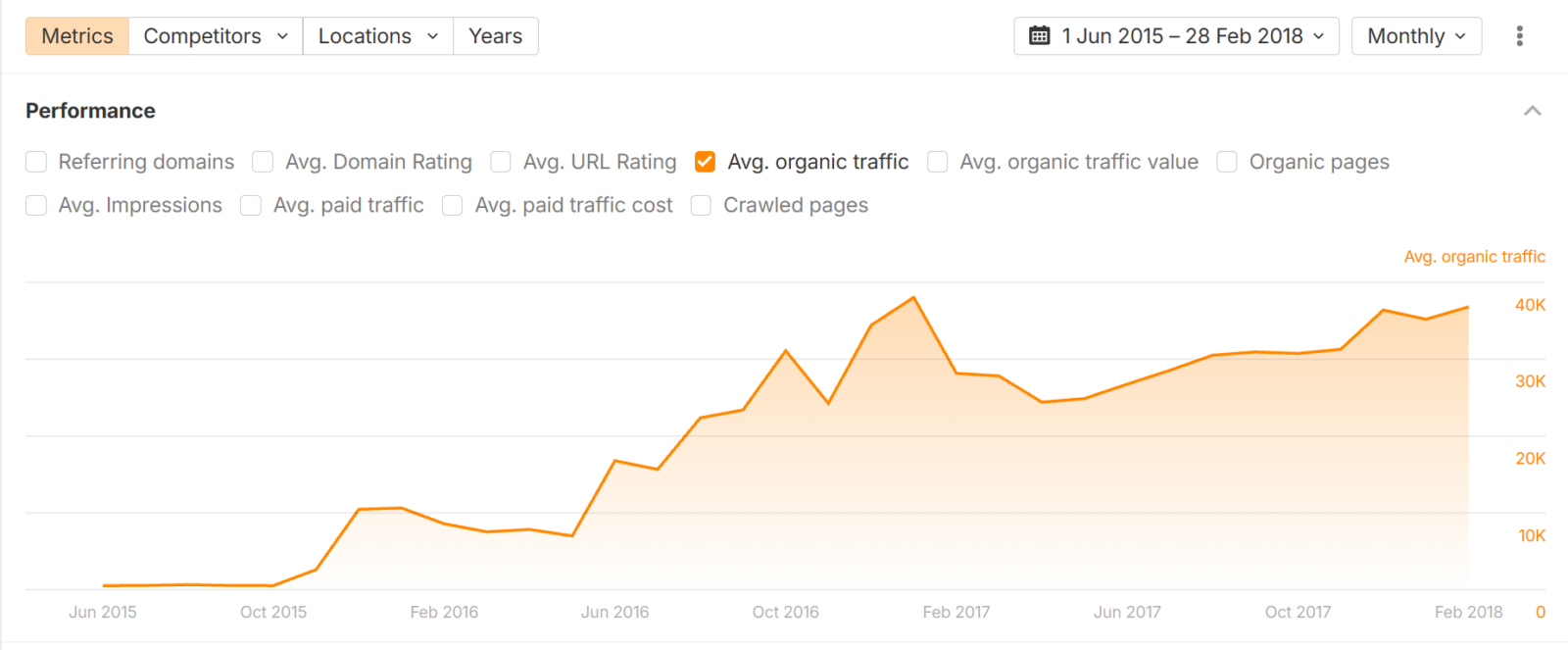
- +200%
- organic traffic
- +625%
- conversion rate
- Top 3
- average position, every major market
- 56
- locations, all indexable
01 — The challenge
Fifty-six facilities and nothing a local searcher could land on.
Public Storage Canada ran storage facilities across four provinces and, as far as search was concerned, owned almost none of them. The build the company had been on since 2008 published one province-level list page per region, and every individual store sat behind a query string along the lines of location-city.php?ProvinceID=3&CityID=8&StoreID=31.
Someone searching “self storage Toronto” had nothing to land on, because nothing existed at that level.
The pages that did exist were not doing much for themselves either.
- No city tier at all. The query that carries the volume in this category had no matching page anywhere in the architecture.
- A homepage with no content on it. Title tag “Public Storage”, no meta description, no H1, no body copy, just two promotional banners and four grey utility buttons.
- Duplicated and truncated listings. The Ontario list page repeated four of its 24 branches and cut several addresses down to a street number and a postal code.
- Store pages built like forms. Two thin paragraphs, an H5 around the phone number, and the services available at each site rendered as a column of disabled checkboxes.
- No structured data anywhere on the domain, and no viewport meta tag, so nothing responded on a phone.
- Navigation written in the company’s own vocabulary. “Branches”, “Merchandise” and “Advice/FAQ” under the tagline “Canada’s leader in warehousing”, rather than the words customers were typing.
The conversion path had the same problem.
- Nine fields to make a reservation, including a confirmed email address, a secondary phone number, an estimated stay in months and a unit size in square feet.
- No reservation at the end of it. The form closed by explaining that a representative would call back with availability, which makes it a callback request.
- A calculator that answered a different question. The only tool on the site that could have supplied the unit size the form was demanding ran to roughly 60 numeric inputs across six tabs, then returned a cubic-foot number the customer had to look up in a static conversion table themselves.
02 — The strategy
Map the demand first, then build pages that match it.
The platform came first. The site was hosted at Network Solutions and the team wanted a CMS they could run without filing a ticket, so we moved them to WordPress on WP Engine. In 2016 that combination bought three things at once.
- Editors could publish a location page themselves.
- The host held up when a national promotion ran.
- We finally had a template layer worth building an architecture on.
It also let us handle the bilingual requirement properly through WPML, which mattered more than it sounds. The old build had been shipping English and French in the same interface, down to a “Calculate” button sitting beside an “Effacer” button on the same form.
Then the keyword mapping, before the design rather than after it. All 56 facilities were mapped against the local queries with real volume in their markets, which answered the question the old site had never asked. How many indexable pages should this site have, and what should each one be about? The answer came out as two tiers.
- City pages. One per market at
/self-storage-toronto/, targeting “self storage” plus the city name and its variants. - Store pages. One per facility, nested beneath its city at the street address (
/self-storage-toronto/36-vine-avenue/), targeting the intersection and neighbourhood language people use once they already know roughly where they want to be.
A structure like that only works if the pages have something on them. City pages got a Quick Facts block with local population and unit-count figures (cited to Statistics Canada), a passage on what storage demand looks like in that particular market, and a short descriptive block per facility written around real neighbourhood references, Liberty Village and The Junction and the Discovery District, instead of the boilerplate the old store pages had been repeating. Store pages got addresses in PostalAddress markup, amenity detail, hours, review counts and a reserve path that went somewhere.
Off the site, we ran the local campaign that makes local pages rank. We claimed and maintained the Google My Business listing for every facility, built local citations across the directories that count in Canadian self storage, and went after locally relevant links. Organic listings and the local pack score on overlapping but not identical inputs, and a brand with 56 physical locations needs both of them working or the map result hands the click to whoever else is nearby.
The conversion path changed the most. We replaced the nine-field reservation form with a seven-field quote form that inherits location context from the page the customer arrived on, rebuilt the calculator so it returns a suggested unit size rather than a cubic-foot number, put “Get a Quote” and “Pay My Bill” in the header sitewide, and added a city-or-postal-code search to the homepage with quick links to the four biggest markets. Customer reviews moved next to the form instead of living on a page of their own.
- A two-tier local architecture. One indexable city page per market, with every facility nested beneath it at its own street-address URL, replacing a store network that had only ever existed behind query strings.
- Keyword mapping across all 56 locations, done ahead of the template work, so the pages that got built matched the queries that had volume.
- Google My Business claimed and maintained per facility, plus local citations and locally relevant links, so the organic listing and the local pack pulled in the same direction.

03 — The results
Top three in every major market, and a conversion rate that moved further than the traffic.
+200%
organic search traffic
+625%
conversion rate
Top 3
average position across every major market, organic and local pack
100%
store-page indexation, from a parameterized set Google largely ignored
Traffic roughly tripled, which is the figure most people look at first. The conversion rate is the one worth looking at second, because a 625% lift on flat traffic would have been a good year by itself. The two compound. City pages brought in people searching by market rather than by brand, and by the time they arrived the quote path was built to take them.
The architecture also stopped being the bottleneck. When the new Airdrie, Alberta facility opened, putting it live meant publishing one store page under an existing city page rather than requesting a database row and a query string. That’s the part a marketing team feels every month, and it’s usually what decides whether a redesign still holds up three years later.
"Under his guidance we saw a 6× increase in traffic and conversions. Speed and quality are often mutually exclusive — Marc is one of the few that can produce both."
 Aaron Mullally
AVP, Public Storage Canada