

Content marketing is the practice of attracting and holding a defined audience by publishing material they find useful, rather than by buying their attention through paid media. The exchange is explicit (albeit oversimplified): you give away something of genuine value (an explanation, a tool, data nobody else has) and in return you become a candidate when that audience is ready to buy.
What content marketing is not
Content strategy is the decision layer: which audiences, which topics, who owns what, what you will stop doing, and how you will measure it. Content marketing is one of the things a strategy might decide to do. An organization can run a large content marketing operation with no strategy at all, (and many do).
Advertising rents attention: the impressions stop the day the budget stops, and the asset is disposable by design. Content marketing builds an asset that keeps working, more slowly, and with far less control over timing. Neither is superior but when paid media fails, it’s very easy to point out, because it’s expensive and that price tag does a pretty good job of capturing the c-suite’s attention. When content market fails, it does so cheaply (and often invisibly); which is arguably why it goes unexamined relative to paid programs.
If you need pipeline this quarter, you buy it. Content marketing is a decision to trade speed for compounding, it does not produce results overnight.
The B2B case is structurally different
Most content marketing advice is written from consumer examples and then applied to enterprise software, where almost none of it holds.
Gartner’s research on complex B2B purchases puts the typical buying group at six to ten decision makers, and finds that buyers spend only about 17 per cent of their total purchase time meeting with potential suppliers at all (spread across every vendor they are considering). Practically, this means:
- You are not writing for a buyer. You are writing for a committee. The champion needs an argument they can repeat internally when you are not in the room. That is a different artifact from a page that convinces the champion.
- The blockers never visit your blog. Security, procurement and legal search for compliance terms, data residency, and contract language. Those pages get a fraction of the traffic and appear in a materially higher share of deals that close.
- The cycle outlasts your attribution window. If the average deal takes nine months and your reporting looks back 90 days, the content that started the deal is invisible to the model that decides whether content gets funded.
- Volume metrics mislead in a specific direction. The pages that draw the most traffic in B2B are almost always the broadest and least commercial. When marketing optimizes for sessions, traffic will generally drift towards an audience that will never buy, even if the dashboard will look excellent throughout.
The correction is not more measurement. It is measuring a smaller number of the right things: performance by topic rather than by page, coverage of the questions that actually come up in sales calls, and a crude assisted-pipeline number agreed with finance in advance so the argument happens once.
Most content marketing does not work
It’s a hard pill to swallow. The majority of content marketing campaigns I have seen produce traffic that does not convert, or do not produce traffic at all, and are sustained by reporting that measures activity rather than outcome.
The common causes are boring and consistent:
- It says what everyone else says. An article assembled from the first page of results for its own keyword has nothing to offer a reader who has already read that page. It cannot be cited, recommended or remembered, because there is nothing in it that is only there.
- Nobody distributes it. Publishing is not distribution. A piece with no plan for who sees it beyond the hope of ranking is a lottery ticket, and organic search takes months to settle even when it works.
- It stops too early. Compounding assets compound. A program cancelled at month nine bought the cost and none of the benefit, which is the worst available outcome, and one that I see very often.
- It is produced by people with no access to expertise. A freelancer with no line to your engineers or your customers can only produce a summary of public information, however well written.
If the piece could have been written by someone who has never worked at your company, it will perform like something written by someone who has never worked at your company.
When & why content marketing does work
The programs that work share three characteristics. Hint: none of them is a content calendar.
They have an informational advantage. Data from their own product, a view of the market only their position gives them, practitioners who have done the thing. This is the only durable moat in content, and it is the thing generative tools cannot replicate, because a model cannot know what your support tickets say. Google recently referred to this as non-commodity content.
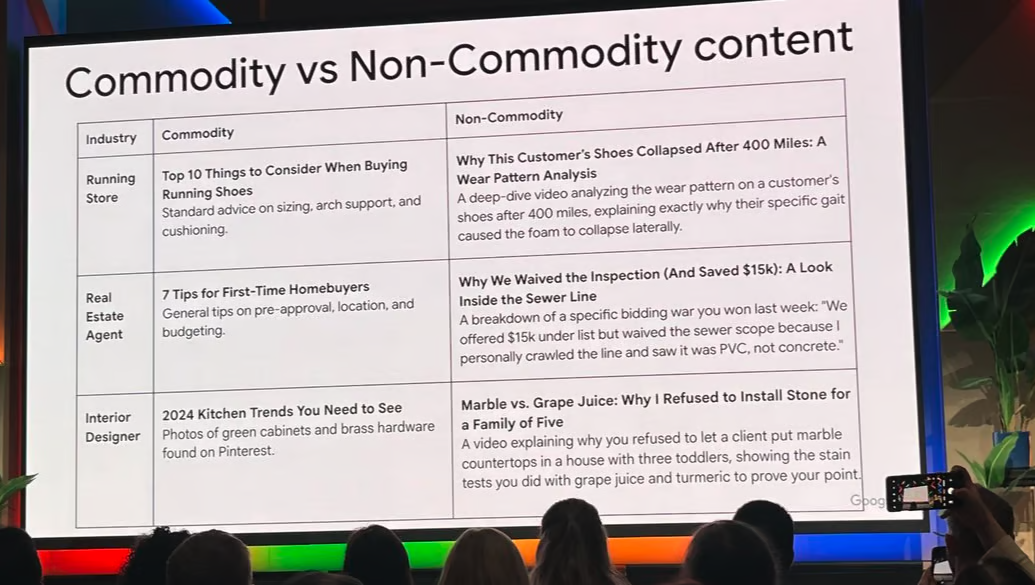
They have a distribution plan per piece. Search is one channel among several. The pieces that break through usually get their first audience from somewhere with a human on the other end: a newsletter, a community, a conference talk, a partner. Search compounds afterwards.
They persist past the discouraging middle. Every program has a stretch where the numbers do not justify the spend and the only honest answer is that it is too early to tell. Surviving that stretch requires having agreed the time horizon before starting, in writing, with the person who controls the budget.
The concession: none of this guarantees anything, and in a category where three competitors have a decade of authority and a research team, the honest recommendation may be to spend the money on earning citations and links or on paid acquisition instead. Content marketing is not always the right instrument. It is just the one that is always recommended.
How to get started with content marketing
Answer one question before commissioning anything: what does your company know that its competitors do not, and who inside the building knows it? If there is no answer, the program will produce summaries, and summaries do not work.
If there is an answer, start with the four or five pieces that only you could write, give each one a distribution plan with a named channel, and agree on a 12-month horizon with whoever signs off the budget. Fewer pieces, harder to produce, distributed deliberately — that is the version of content marketing that survives contact with a spreadsheet.