












Skip to content
Marc Nashaat Consulting Start a conversation

Content Audits

An established site rarely has a content gap. It has a content surplus. A content audit decides what to keep, merge, rewrite and delete across thousands of URLs — and produces the evidence you need to defend deleting things, which is the part most organizations find impossible.

Content Audits programs for FacilityOS Touchbistro belairdirect BMO FedEx Public Storage

Overview

What is an SEO content audit?

An SEO content audit is a systematic assessment of every indexable page on a site against the demand it targets, the traffic and revenue it produces, and the other pages it overlaps with. The output is a disposition for each URL: keep, rewrite, consolidate into another page, or remove and redirect. On an enterprise estate (e.g five thousand URLs accumulated over a decade, across two CMS platforms and three reorganizations) the inventory itself is usually the first thing nobody has.

The analysis combines a full crawl with Search Console query and impression data, analytics, referring-domain counts and index status. Two findings recur: decay, where a page that once ranked has been overtaken and never revisited, and cannibalization, where several near-identical pages split signals for the same query. Consolidation addresses both, at the cost of a redirect map that has to be executed carefully, because a botched 301 layer will cost more than the pages were ever worth.

Who it's for

You probably need this if…

  • 01Your site has thousands of URLs and nobody can tell you which of them earn anything.
  • 02Rankings for your most important term move between three of your own pages every month.
  • 03A migration is coming and you are about to carry a decade of dead pages across with you.
  • 04Everyone agrees the archive needs cleaning up and nobody is allowed to approve a deletion.

Key principles of a content audit

Inventory and classification

Before anything is judged it has to be listed. A crawl reconciled against XML sitemaps, the CMS export and Search Console reliably surfaces page types nobody remembered: expired campaign landing pages, orphaned PDFs, duplicate location pages, an entire blog inherited from an acquisition. Classification by template and purpose comes before any performance judgment.
Performance and decay

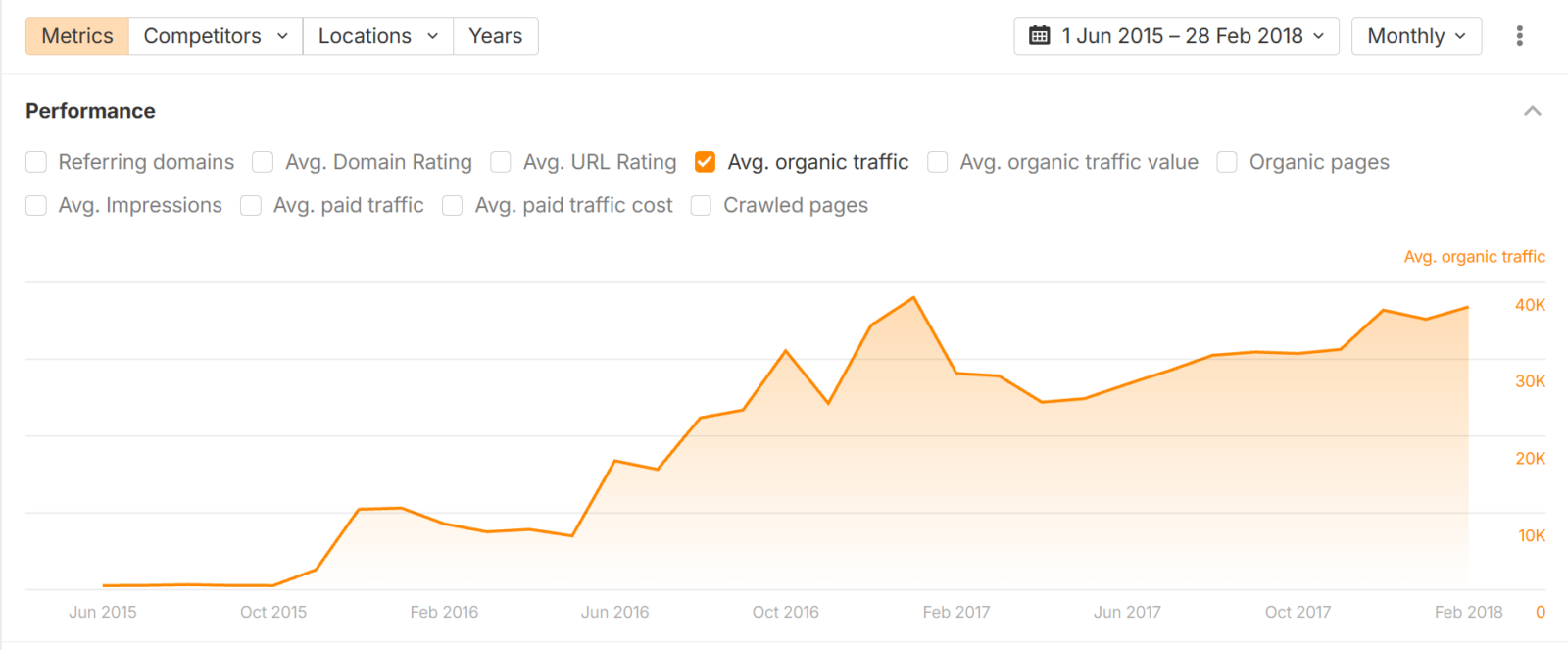
Most pages on a large site earn nothing and never did. A much smaller set earned well and has been declining quietly for two years because the query moved or a competitor rewrote theirs. Separating never-worked from stopped-working matters, because the second group is the cheapest traffic available to you.

Cannibalization

When several pages target the same query, search engines pick one (often the weakest, and sometimes a different one each week). The symptoms are rank instability and impressions spread thinly across URLs that should have been a single page. Search Console query-by-page data is the evidence; consolidation is the fix.

Consolidation and redirect risk

Merging pages means 301s, and 301s at scale are where audits go wrong. Chains, loops, redirects to irrelevant parent categories and internal links left pointing at dead URLs will undo the gain. The mechanics (mapping, internal link updates, a staged release and post-release monitoring) matter as much as the decision.

What's included

Deleting is a strategy.

Full inventory

Crawl, sitemap, CMS and Search Console data reconciled into one list of every indexable URL, classified by template and purpose.

Performance & decay

Traffic, query coverage, conversions, referring domains and index status per URL; Separating pages that never worked from pages that stopped.

Cannibalization mapping

Query-by-page data showing where your own URLs compete, with a merge target and a surviving canonical named for each cluster.

Redirect map & governance

The 301 plan, internal link updates and the publishing rules that stop the same sprawl accumulating again over the next three years.

Not sure which of these you actually need?

Request a discovery call

Process

How I approach Content Audits

  1. 1

    Inventory

    Crawl, exports and access, reconciled into one classified list of every indexable URL.

  2. 2

    Analysis

    Performance, decay, overlap and cannibalization scored per URL against real demand.

  3. 3

    Decisions

    Keep, rewrite, consolidate or remove; Signed off with the people who own each section.

  4. 4

    Execute & monitor

    Redirects, internal links and removals staged and released, then watched against the baseline.

FAQ

Common questions

Is deleting content actually safe?

Removing pages that rank for nothing and earn nothing is usually the lowest-effort, highest-return action available on an old site. What is not safe is removing them without a redirect map, or removing a page that quietly holds forty referring domains. The audit exists to tell those apart.

How large a site can you audit?

There's no limit. Beyond a few thousand the work stops being page-by-page and becomes template and cluster level, with sampling to validate the calls. The shape of the output does not change; the unit of decision does.

Legal and comms will never approve removals. Then what?

That is the normal answer, and it is why most audits die in a spreadsheet. The workable path is noindex plus internal link removal for anything that has to stay published, and consolidation rather than deletion where a page has a defender. I will tell you which fights are worth having.

Could we just use a content audit template?

A template gives you columns. It does not give you the disposition, which is the judgment (whether a decaying page is worth rewriting, whether two pages should merge, and which of the two survives). The spreadsheet is the cheap half of this.

Related resources

How much of your site is earning nothing?

Send me your domain and a rough URL count. I will tell you what the audit is likely to find. I reply personally within 48 hours.