
Moving a five-year-old domain to a new brand without losing the rankings
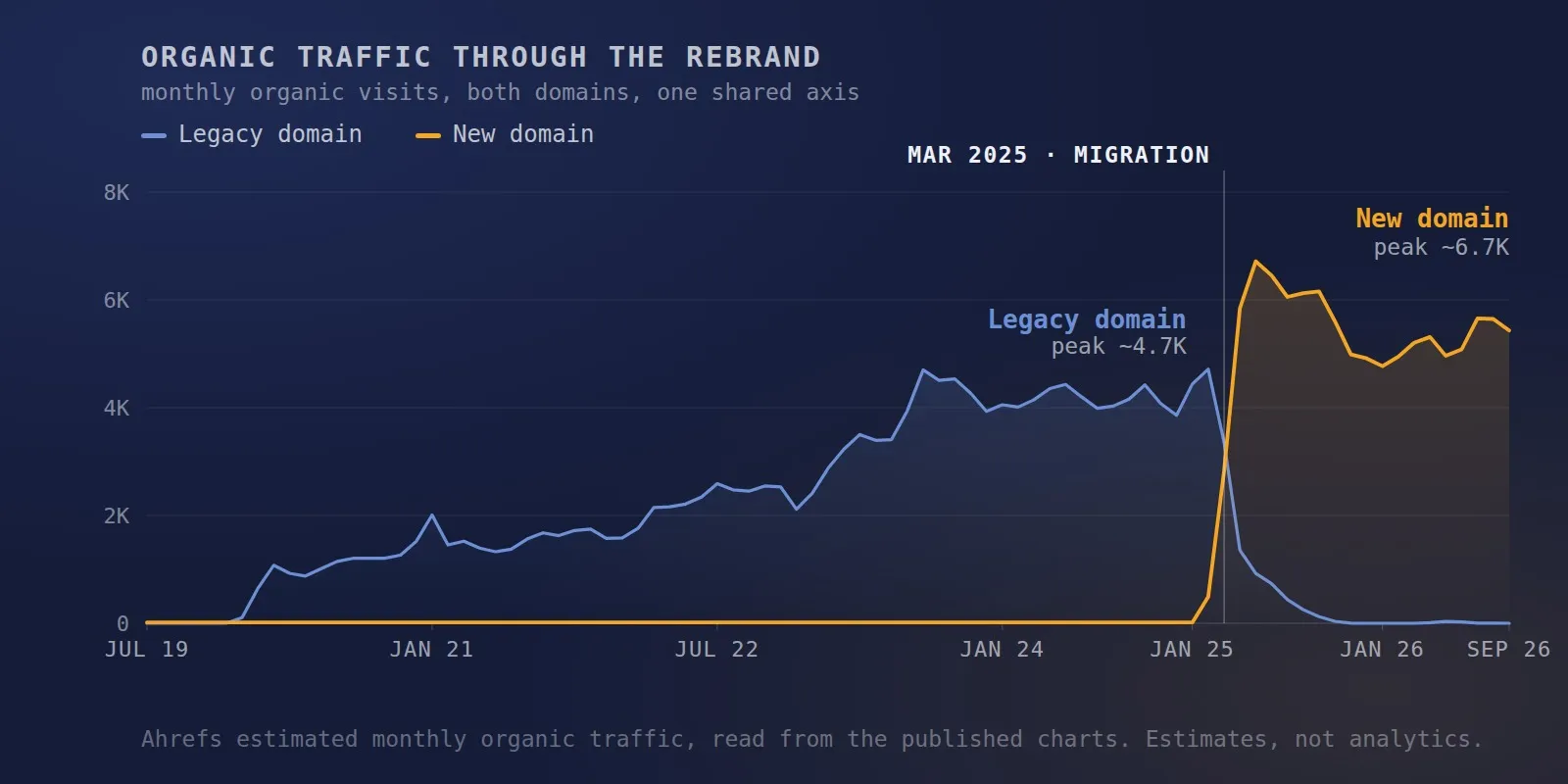
A five-year-old domain carrying all of the company's rankings and links had to be abandoned for a new brand. The migration held, the new domain passed the old one's all-time peak, and MRR from organic doubled year over year.
- +103%
- MRR from organic
- +81%
- sales opportunities
- 40%
- of pipeline opportunities from organic and direct
- 3+ yrs
- retained, and still going
01 — The challenge
A rebrand that meant abandoning five years of domain equity.
The company was changing its name, and the domain that carried five years of accumulated rankings, links and brand recognition was the name it was leaving behind. Every URL on the site would move at the same time.
A domain change is the highest-risk thing you can do in organic search, and the downside is not symmetrical with the upside.
Done well it is invisible. Done badly it takes eighteen months to recover, and in a category where a handful of competitors were already compounding authority faster than we were, eighteen months is the whole game.
The harder problem was that there was nothing to rebuild against. The existing site had grown by accretion rather than to a plan. There was no keyword map, no defined page inventory and no rule about which page owned which query, so pages competed with each other and nobody could say what the new site should consist of. A migration copies the existing architecture onto a new domain. Where that architecture is undefined, the migration carries the problem across intact.
The site also carried the usual accumulated debt of a company mid-rebrand.
- Calls to action for the old brand on nearly every blog post.
- Broken CTA images on about 30% of them.
- A login subdomain that kept resurfacing in the index and quietly absorbing branded traffic that belonged to the main site.
02 — The strategy
Map the pages the new site needed, then migrate against a measured panel.
The keyword work came before anything was designed. Demand research across the category produced a target set filtered by what the business actually sells rather than by search volume, and every term in it was assigned to exactly one page. That assignment became the page inventory for the new site. Which pages to carry across, which to merge, which to build, and which to let go.
Then the pages themselves. Hi-fi wireframes for the priority templates, with the keyword assignment, the heading structure and the internal linking specified on the wireframe rather than left to be interpreted during the build. The in-house team built from those, and I stayed in the build rather than handing the documents over and waiting, reviewing staging, correcting markup and answering the questions that only surface once something is being implemented.
The migration went live in March 2025 and was measured on a fixed panel of 55 priority keywords tracked before, through and after the cutover, rather than on sitewide traffic, where a seasonal dip and a migration failure look identical for the first six weeks. The panel averaged:
- February, position 10.4
- End of March, 13.4
- Early April, under 9
- End of April, 12.5
That is what a healthy migration looks like from the inside. A dip, an overshoot, then a settle. Sitewide, the first full month on the new domain came in 134% up on non-branded clicks year over year and 296% up on impressions, and third-party estimates put the new domain past the old domain’s all-time traffic peak within weeks.
On top of that went the structure the map had specified.
- Product and feature pages for each line the company sells.
- A resource hub with an explicit URL convention and anchor-text rule set, so informational and commercial pages stopped competing for the same queries.
- Industry pillars with subpages beneath them, which funnel analysis later justified. Subpage visitors who reach the demo page complete it at 79% against 53% for the parent pages, from 31% less traffic, and that held across two independent measurements.
- A consolidation pass that routed the main commercial intent into the hub and the product page, and folded in the legacy guide that had been splitting it.
A lot of the month-to-month work is unglamorous and matters more than it sounds. Login subdomain indexation rules that keep needing reinforcement. Internally linked 404s. Commercial pages ranking positions five to eight with no internal links pointing at them. A schema graph covering the platform and its product catalogue.
None of it makes a chart move on its own. All of it is why the charts move when the content lands.
- A migration measured on a fixed 55-keyword panel, tracked before and after the cutover, because sitewide traffic cannot tell a seasonal dip apart from a failed migration until it is too late to act.
- A keyword map that assigned every target term to exactly one page, which became the page inventory for the new site and the specification the wireframes were built against.
- A resource hub with its own URL and anchor-text rules, plus industry pillars with subpages, which convert demo visitors at 79% against 53% for the parent pages from 31% less traffic.
03 — The results
Six weeks of volatility, then more traffic than the brand had ever had.
+103%
MRR from organic, Q2 year over year
+81%
sales opportunities, Q2 year over year
+62%
leads, Q2 year over year
+134%
non-branded clicks, first full month on the new domain
The reporting line to leadership was never sessions. It was leads, opportunities and recurring revenue. Across the first full fiscal year of the engagement records rose 58%, and the quarter straddling the migration returned a doubling of organic MRR year over year. Over a rolling twelve months, organic and direct together produced 40% of every non-offline sales opportunity from 11% of the leads, which is the ratio worth reading rather than the share.
The migration is the part worth dwelling on, because the counterfactual is invisible. A rebrand this size usually costs a year of organic performance. This one cost about six weeks of rank volatility and then returned more traffic than the brand had ever had under its old name.
04 — Inside the engagement
Three years, thirty-three monthly reviews, and a remit that kept widening.
The retainer started as technical SEO and did not stay there. What it consists of now is closer to a growth function than a channel, and most of it only works because of access to the things a vendor does not normally get near: the sales call recordings, the CRM, the development backlog and the annual planning cycle.
- Technical SEO
- Migration planning and post-launch monitoring, indexation rules on the login subdomain, a schema graph covering the platform and its product catalogue, and crawl and internal-link audits every month.
- Content strategy
- Keyword maps per product line, the resource hub architecture with its URL and anchor-text rule set, briefs written for the in-house writers, and a pruning pass against clicks-per-month thresholds twice a year.
- CRO and page design
- Hi-fi wireframes for the product and feature pages, plus funnel analysis across industry parents and subpages that located where the demo path loses 96% of both audiences.
- Competitive intelligence
- A ten-competitor share-of-voice benchmark with a core-scope filter, backlink velocity tracking, content-format gap analysis, and page-level teardowns of where rivals out-rank us and why.
- Authority research
- Affinity modelling across 100 ranked properties to find the twenty the buying committee actually reads, then trade media, associations and analyst targets ranked by reach against domain authority.
- Measurement
- A monthly review to marketing leadership in leads, opportunities and MRR rather than sessions, an LLM visibility dashboard, and annual scope and roadmap planning.